Slow way down.
This is the first week of the work we do with every person who walks into our studio, in the order we do it. Three days. About ten minutes each.
There is one instruction that runs through all three days, and Deidre says it to every new client: I slow way down. I observe. I take a deep breath and I observe.
That is it. You are not fixing anything this week. You are getting quiet enough to notice what is already there. Most people have never been asked to do only that, which is why it feels strange for about a day.
Words
With Jenna · about 7 minutes · have a pen and paper
You have a sentence you say about your body. You have said it so many times you no longer hear it.
It sounds like my back is just like this now, or I am always tired, or there is just not enough of me to go around. It is not a lie. It is a conclusion you reached a long time ago, and your body has been organizing itself around that conclusion ever since.
Today you are not going to argue with the sentence. You are going to slow it down enough to hear it, and then ask your body one question about it.
The practice, about ten minutes
- Sit somewhere you will not be interrupted. Phone in another room. Feet on the floor.
- Out loud, say the sentence you say most often about your body or your energy. Out loud matters. Saying it in your head does not count.
- Say it again, at half speed. Slower than feels natural. Notice what happens in your chest, your jaw, your shoulders while you say it.
- Now ask yourself the question we ask every client: where do I feel that in my body right now?
- Name the place. Left shoulder. Base of the throat. Behind the ribs. Do not fix it, do not stretch it, do not explain it. Just name it.
- Write one line on paper: the sentence, and where you felt it. One line. That is the whole record.
If nothing comes up. That is a normal day one. Bracing is a skill, and you have been practicing it for years. Sit for another two minutes and ask a smaller question: is there anywhere in my body that is not relaxed right now?
Tonight, before you sleep: read your one line back. Do not add to it.
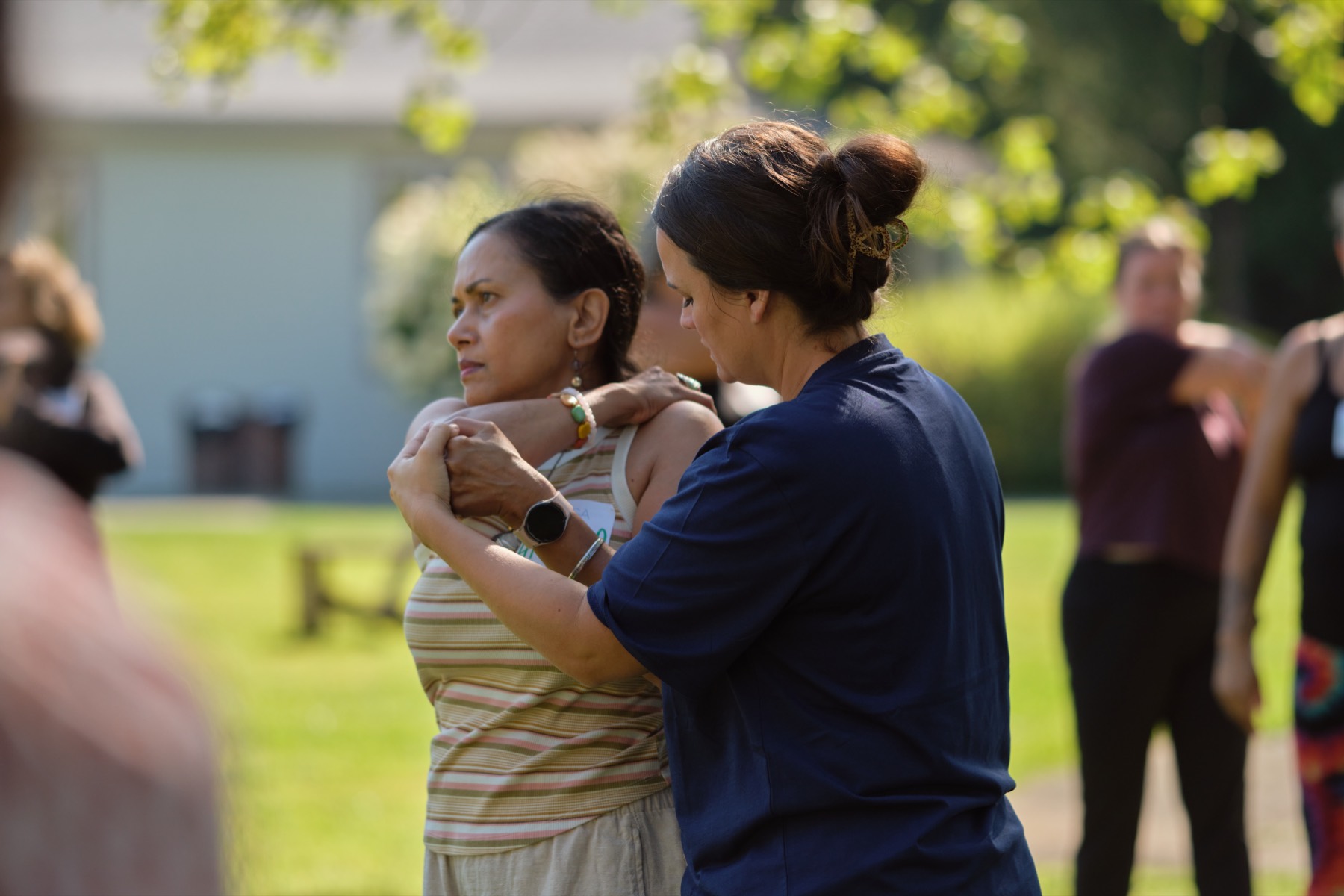
Movement
Follow along with Deidre · about 11 minutes · follow along seated, or use the floor version below
Only ever with the car parked. Move within what is comfortable, and if anything hurts, come out of it.
Today you move, and the point is not the movement. The point is what you find while you are doing it.
Yesterday you asked where you felt something. Today you go looking on purpose, with the body moving slowly enough that it can actually answer. This is not a workout. If you get warm, you are going too fast.
The practice, about ten minutes
- Lie on the floor on your back. Floor, not a bed. Knees bent or straight, whichever lets your lower back settle.
- Lie still for one full minute before you move at all. Let the floor hold your weight. Most people have not put their whole weight down in a long time.
- Move slowly through the places you carry: roll your head side to side, let your shoulders travel, let your ribs and hips shift. Go at a quarter of your normal speed. You are searching, not stretching.
- When you find a place that does not want to move, stop there. Do not push through it. Stay with it and breathe.
- Ask the three questions, in this order: Is this area tight? What emotion is connected to it? Is there a story tied to it?
- Come back to stillness for one minute. Then write one line: where you found it, and what came with it.
The observation is internal, not external. We are not asking how it looks or how far it goes. We are asking what you feel, what emotion is sitting there, and whether a memory arrives with it. Often one does. That is information, not a problem.
Move within what is comfortable for you. Nothing here should hurt. If something is painful, come out of it and move somewhere else.
Breath
With Jenna · about 13 minutes
Take contact lenses out first and keep the pressure feather-light. Skip the eye work if you have had eye surgery or have an eye or heart condition, and stop if anything feels uncomfortable.
Words, movement, breath. Today they run together, and this is the one most people skip.
The two days before this were about noticing. Today the breath is what gives the body somewhere to put what you noticed. Ten minutes, ideally in the evening, because if your mind has been refusing to shut off at night, this is the practice that meets it.
The practice, about ten minutes
- Sit or lie down. Lights low. Say your day one sentence out loud one more time, at half speed.
- Put a hand where you felt it on day one, and the other hand where you found something on day two. If they are the same place, use both hands there.
- Breathe in through your nose, unhurried. Let the breath arrive under your hands rather than up in your chest.
- Let the breath out slowly, longer than you drew it in. No counting, no technique to get right. Longer out than in is the whole instruction.
- Ten breaths like that. After each one, ask: what do I feel now? Not what should I feel. What do I feel.
- Lie still for two minutes afterwards without doing anything at all. This part is not optional and it is the part everyone cuts.
- Write your last line: the three days, in one sentence, in your own words.
If your mind wanders off, it has not gone wrong. Notice where it went, and come back to the next breath out. You will do this thirty times in ten minutes. That is the practice, not a failure at the practice.
That is the reset. Three days of slowing down, observing, and breathing.
What we will say is this: if any of those three days gave you something you had not noticed before, that is not a small thing. That is your body answering the first time it was actually asked.
Two ways to keep going.
Find out where your body needs you to start
A short set of questions that sorts you toward one of the three: words, movement or breath. You get one practice to run for a week, chosen by how you answered.
Work with us directly
If these three days told you something and you would rather not sort out the rest of it alone, come and sit with us. One session, no package, no commitment.